


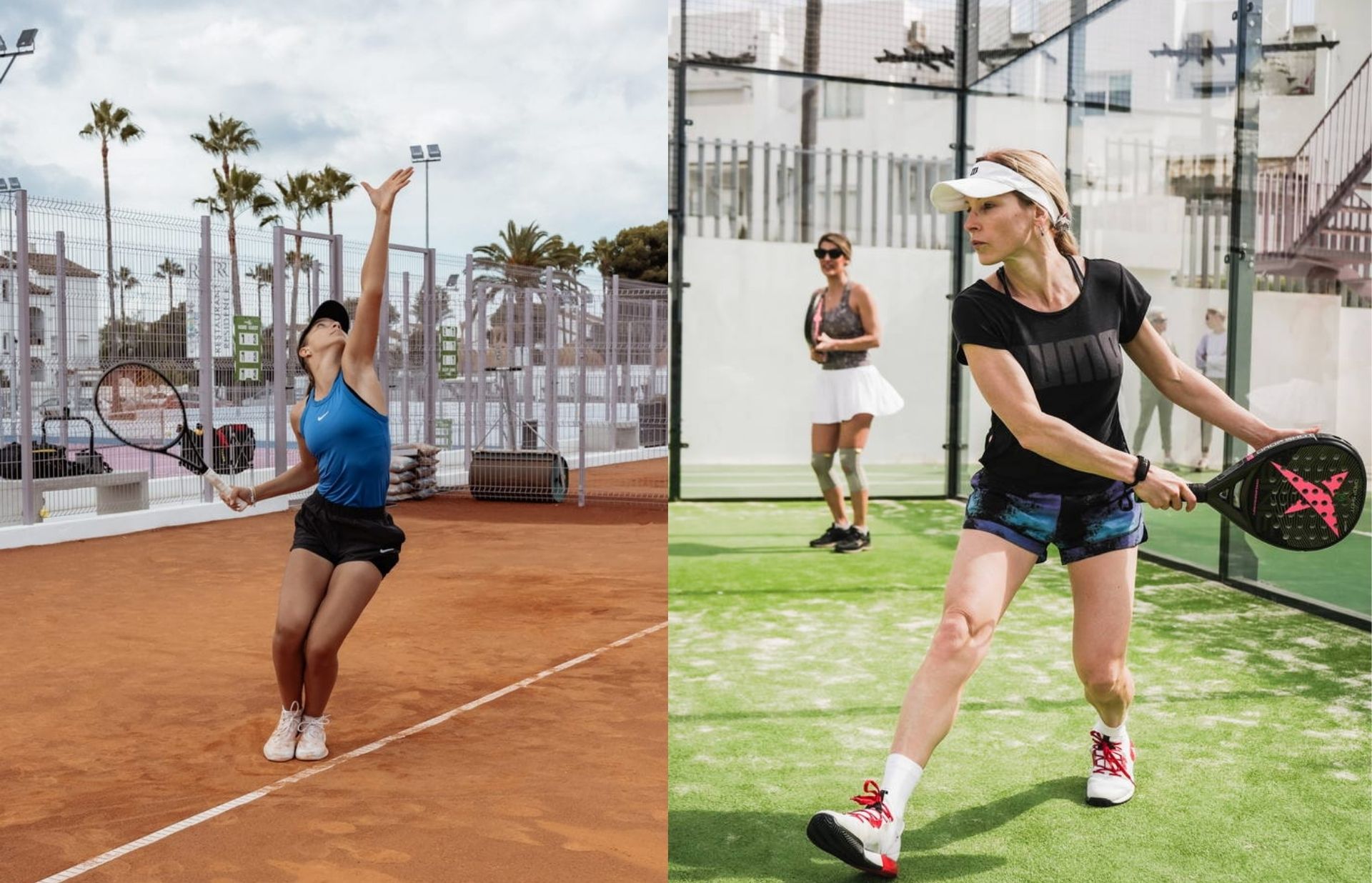
Choosing the right racket is a decision that directly affects both your performance on the court and the health of your joints. In both tennis and padel, the market offers a huge variety of options, which can be confusing if you do not know which factors to prioritise according to each player’s profile.
At RozaRossa Tennis Academy, today we want to share some tips to help you choose the right tennis or padel racket.
Tips for choosing a tennis or padel racket
Before looking at the brand or the latest popular model, there are several practical things you should consider to make the right choice.
Be honest about your actual playing level
It is very common to think we play better than we really do, and this often leads to choosing demanding rackets that punish every shot that is not perfectly executed. If you are still learning or improving your technique, you will benefit more from a racket that is more forgiving, allowing you to enjoy the game while improving instead of feeling frustrated with every point.
Think about your physical condition first
Your strength, endurance, and how well you cope with a long match matter more than any technical specification. If you have little strength in your arm, you will notice fatigue sooner with a heavy racket. If your arm is well trained, that same weight can help you hit with more power without putting in extra effort. Knowing your own limits is the first step before looking at any technical specifications.
Be clear about your playing style
Playing comfortably from the baseline is not the same as trying to finish points at the net. If you usually stay at the back of the court, you need help generating enough power to reach the other side. If you prefer coming to the net, a lighter racket that is easier to manoeuvre will suit you better. Understanding how you actually play helps you avoid buying a racket designed for a style that is not yours.
Try the racket before buying it
No technical specification can replace the real feeling of hitting with a racket on the court. What seems perfect on paper may not suit you, and vice versa. Trying different models in real playing conditions is the best way to know whether a racket is truly right for you.
Pay attention to the signals your body gives you
If your elbow, wrist, or shoulder hurts after playing for only a short time, something is not right, and it is rarely just a matter of technique. Early arm fatigue, tingling, or strong vibrations when hitting the ball are clear signs that your equipment is not suitable. The sooner you check it, the sooner you can avoid an injury that could have been prevented.
Ask a professional for advice before deciding
Once you have considered your level, your physical condition, your playing style, and how your body feels, the final step is to discuss it with a coach. A professional can notice details you may overlook, such as a racket that is too light for your stroke or a grip that forces you to squeeze harder than necessary.
That outside perspective is often the difference between choosing the right racket the first time or trying several models before finding the right one.
Characteristics of tennis and padel rackets
Although both are designed for the same purpose, hitting the ball well, a tennis racket and a padel racket are built very differently. Understanding these differences helps you know what you are actually buying.
Tennis rackets
A tennis racket has several technical features that determine how it performs with every shot:
- Head size: larger heads make hitting easier and are more forgiving; smaller heads provide greater precision but require more consistency.
- String pattern: a more open pattern offers more spin and power; a denser pattern provides more control and lasts longer.
- Frame length: most rackets measure between 68 and 71 cm; the longer the racket, the greater the reach and serving power.
- Material: graphite is the most common material because it offers a good balance between stiffness and light weight.
- Weight: usually between 250 and 340 grams, which determines whether the racket is easier to manoeuvre or generates more power.
Padel rackets
In padel, the racket has no strings, so its characteristics are different:
- Shape: round rackets provide more control, teardrop-shaped rackets offer a balance between control and power, and diamond-shaped rackets deliver more power because the weight is concentrated higher up.
- Surface: it can be smooth or perforated; the holes help generate more spin on the ball.
- Core: it can be made of EVA rubber, which is firmer and designed for greater control, or foam, which is softer and more comfortable for the arm.
- Core hardness: the softer the core, the more it protects the arm; the harder it is, the more power it returns but the better your technique needs to be.
- Frame material: fibreglass is more flexible and affordable, while carbon fibre is stiffer and designed for more advanced players.
Join tennis and padel classes
At RozaRossa Tennis Academy, we know that every player is different. That is why we believe the best way to improve is not only by choosing the right racket, but also by having a professional watch how you really play. Our coaches can help you improve your technique, match your equipment to your level, and avoid the discomfort that often comes from poor technique or unsuitable equipment.
We are a tennis and padel academy in Estepona and Marbella offering both individual and group lessons for all levels, whether you are just getting started or looking to take your game to a more competitive level.
Come and try a session with us, tell us about your goals, and we will help you find the best way to enjoy tennis and padel without limits.
Latest news and events


You’ve probably heard of the ATP Tour while watching a tennis match. But do you really know what the ATP Tour is and why it is so important for players who want to pursue professional tennis? Find out here! What is the ATP Tour? The ATP Tour is the circuit organised by the ATP (Association of Tennis Professionals), the association that represents male professional tennis players. It brings together the tournaments in which players compete for points, prize money and prestige. Players such as Rafael Nadal, Roger Federer and Novak Djokovic have built their careers on this circuit. Each season starts in January and ends in November with the ATP Finals, where the eight best players of the year compete…

Mikhail Kukushkin, one of Kazakhstan’s most renowned tennis players, has returned to the courts in Almaty to compete in the Almaty Open ATP 250, the final tournament of his professional career. He is competing thanks to a wildcard from the organizers, who have given him the opportunity to play in front of his home crowd one more time. The day before his debut, he played an exhibition match against Alexander Bublik and held a press conference to announce his retirement from professional tennis. A first-round victory On October 19, Mikhail made his tournament debut against Greek player Stefanos Sakellaridis, winning 7–6(4), 7–6(3). Both sets went to a tie-break, and Mikhail came out on top in both. Following his retirement announcement,…
Women's professional tennis brings together players from all over the world who compete in different tournaments throughout the year. The results they achieve in these competitions influence their position in the world rankings and their opportunities on the circuit. Understanding what the WTA Tour is helps provide a better understanding of how this sport works. What is the WTA Tour? The WTA Tour is the international women's professional tennis circuit organised by the Women's Tennis Association (WTA). This organisation was founded with the aim of giving women's tennis greater recognition and improving the conditions for professional players. Since then, the circuit has grown to include competitions in different countries and on different surfaces. Throughout the season, players take part in…
Our Instagram






Book a court, lesson with coach or enroll in fall groups

Book a court, lesson with coach or enroll in fall groups


